
Introduction
Antibody developability refers to the physicochemical and biochemical properties that influence an antibody's suitability for development, manufacturing, and clinical use. In addition to strong target affinity, a viable therapeutic antibody must exhibit favorable solubility, stability, manufacturability, viscosity, and low risk of aggregation and other potential liabilities.
The resulting output provides an overview of the predicted developability profiles of the screened antibodies, based on computational approaches that incorporate both sequence- and structure-based analyses. The evaluated metrics combine machine learning models trained on clinical-stage antibody data with physicochemical property assessments.
Submit a job
Bellow is a figure of the Developability analysis on the portal. The version may change during the development of the workflow, but the latest version is always recommended to use.
Clicking on the RUN JOB button, we can launch a Developability job.

Inputs
The input of the job is sequences of antibodies to assess the developability properties. These can be in FASTA or CSV format where the some small requirements (shown on the right-handed site of the application or as below) must be followed.
Select a single CSV file containing antibody sequences for developability assessment. Two input CSV formats are supported, with the following columns:
- "protein_name", "chain_sequence" (sequence string), "chain_name" (must be VH or VL; leave empty or exclude this column for scFv antibodies);
- "protein_name", "VH_sequence" (heavy chain sequence string), "VL_sequence" (light chain sequence string). For single-chain antibodies (VHH or scFv), only two columns are required: "protein_name" (name) and "VH_sequence" (sequence string).
The developability assessment supports antibodies with Fc domains, though not all predictions evaluate the Fc region.
Or select a single FASTA file containing antibody sequences for developability assessment. FASTA headers must end with '_VH' for heavy chains and '_VL' for light chains. Both chains from the same antibody must share the same base name (e.g., "Ab1_VH" and "Ab1_VL"). For nanobodies, use the nanobody name with a '_VH' suffix; for scFv sequences, use the scFv name without a chain suffix. The developability assessment supports antibodies with Fc domains, though not all predictions evaluate the Fc region.
Example of a valid input FASTA file:
>Atezolizumab_VH
EVQLVESGGGLVQPGGSLRLSCAASGFTFSDSWIHWVRQAPGKGLEWVAWISPYGGSTYYADSVKGRFTISADTSKNTAYLQMNSLRAEDTAVYYCARRHWPGGFDYWGQGTLVTVSS
>Atezolizumab_VL
DIQMTQSPSSLSASVGDRVTITCRASQDVSTAVAWYQQKPGKAPKLLIYSASFLYSGVPSRFSGSGSGTDFTLTISSLQPEDFATYYCQQYLYHPATFGQGTKVEIK
>Bapineuzumab_VH
EVQLLESGGGLVQPGGSLRLSCAASGFTFSNYGMSWVRQAPGKGLEWVASIRSGGGRTYYSDNVKGRFTISRDNSKNTLYLQMNSLRAEDTAVYYCVRYDHYSGSSDYWGQGTLVTVSS
>Bapineuzumab_VL
DVVMTQSPLSLPVTPGEPASISCKSSQSLLDSDGKTYLNWLLQKPGQSPQRLIYLVSKLDSGVPDRFSGSGSGTDFTLKISRVEAEDVGVYYCWQGTHFPRTFGQGTKVEIK
Example of a valid input CSV file:
protein_name,VH_sequence,VL_sequence
Adalimumab,EVQLVESGGGLVQPGRSLRLSCAASGFTFDDYAMHWVRQAPGKGLEWVSAITWNSGHIDYADSVEGRFTISRDNAKNSLYLQMNSLRAEDTAVYYCAKVSYLSTASSLDYWGQGTLVTVSS,DIQMTQSPSSLSASVGDRVTITCRASQGIRNYLAWYQQKPGKAPKLLIYAASTLQSGVPSRFSGSGSGTDFTLTISSLQPEDVATYYCQRYNRAPYTFGQGTKVEIK
Natalizumab,QVQLVQSGAEVKKPGASVKVSCKASGFNIKDTYIHWVRQAPGQRLEWMGRIDPANGYTKYDPKFQGRVTITADTSASTAYMELSSLRSEDTAVYYCAREGYYGNYGVYAMDYWGQGTLVTVSS,DIQMTQSPSSLSASVGDRVTITCKTSQDINKYMAWYQQTPGKAPRLLIHYTSALQPGIPSRFSGSGSGRDYTFTISSLQPEDIATYYCLQYDNLWTFGQGTKVEIK
The pipeline can accept single domain scFv or VHH antibodies by selecting the appropriate option.
In the input field of either "Input sequence CSV file" or "Input sequence FASTA file", the uploaded input file should be selected.
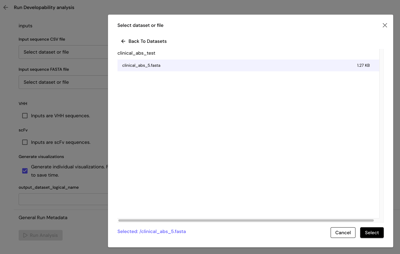
By default, the workflow will generate reports, including a summary and individual reports for the input antibody sequences. If there are more than 300 input antibodies, the workflow will automatically skip making individual reports to save time. Also, when screening too many input sequences, should disable the Generate individual visualizations option since these tasks take time. By default, the pipeline skips individual visualizations for each antibody if there are over 500 input antibodies. In this case, the two tabs "LIABILITY PLOTS" and "HYDROPHOBICITY AND CHARGE" for individual visualizations will be unavailable. The summary report is always generated.
Expected outputs
The expected outputs are as below:
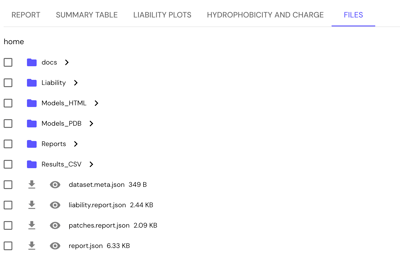
- report.json: The summary report containing overview information and main results of the developability assessments. This file appears as the main report in the REPORT tab
- Reports: Consists of individual report of each screened antibody in the html format. The individual report provides a more detailed description of the developability properties, particularly the comparison of its properties with those of clinical-stage antibodies, as well as the hydrophobicity and electrostatic potential surface of the antibody structure.
- Results_CSV: The predicted developability metrics/parameters in the CSV format:
- main_results.csv: main predicted metrics which is also shown in the summary report and in the SUMMARY TABLE tab
- consolidated_metrics.csv: All predicted metrics/parameters in a single consolidated csv file
- Liability: Contains liability plots and CSV files. All liability visualizations on sequences can be found in the LIABILITY PLOTS tab
- dev_motifs.csv: Chemical developability (DEV) motif liabilities along with antibody sequences. These are also included in the consolidated_metrics.csv.
- ns_motifs.csv: Non-specificity (NS) motif liabilities along with with antibody sequences. These are also included in the consolidated_metrics.csv.
- Models_HTML: Consists of the html visualization of each predicted antibody structure with some features to visualize electrostatic and hydrophobic potentials. This html visualization is also integrated to the individual report of each antibody.
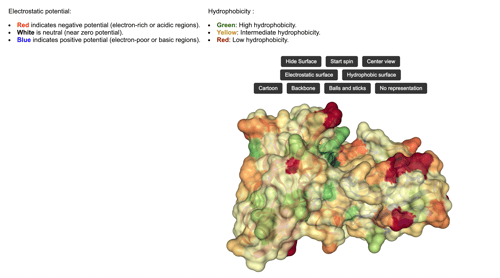
- Model_PDB: Consist of PDB models with PSH (Patches of Surface Hydrophobicity), PPC (Patches of Negative Charge) and PNC (Patches of Positive Charge) features mapped as B-factor. These features can be visualized by using integrated Mol* on the portal or Pymol (locally). The surface hydrophobicity patches can also be viewed directly from the SUMMARY TABLE (column: PSH PDB model) or HYDROPHOBICITY AND CHARGE tabs

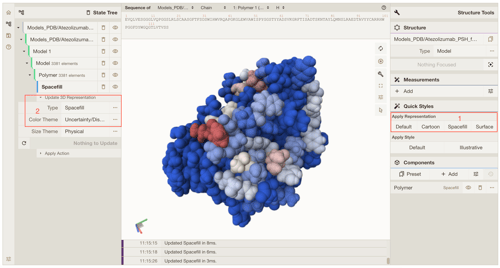
Visualize B-factors using Mol*
- We can use a natural command like “show b-factor as uncertainty” in the Question box.
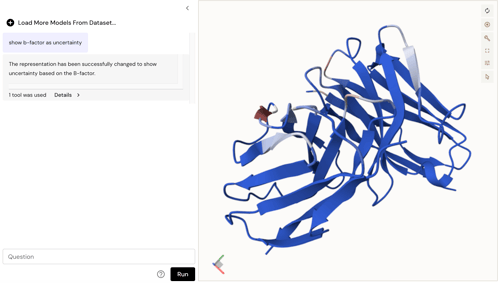
- We can also use interface buttons:
- Type: Spacefill or Surface or Cartoon, …
- Color Theme: Uncertainty/Disorder
Visualize B-factors using Pymol
Use simple command lines:
spectrum b, blue_white_red # or white_red
as surface # or as spheres
Comprehensive description
The main_results.csv contains the following developability metrics which help identify potential developability risks and guide candidate prioritization. Particular attention is given to two composite scores (META X and META Y), which capture key biophysical properties related to cross-/self-interactions and hydrophobicity, respectively. Lower META X and META Y scores are generally associated with more favorable developability profiles, and these composite metrics are useful for ranking the screened antibodies based on predicted assay-derived properties.
Additional metrics include the Aggregation Average Score, which estimates overall aggregation propensity; Scaled Solubility, which predicts protein solubility; and pI and Spatial Positive Charge Map scores, which are particularly informative for assessing non-specific binding risk; and Viscosity Classes, which classify antibodies by predicted viscosity at high concentrations.
The flagging profiles provide a comparative reference to evaluate how closely an antibody's developability features align with clinical-stage therapeutics. In addition, the assessment of common chemical liabilities and non-specificity motifs helps identify potential developability risks early in the candidate selection process.
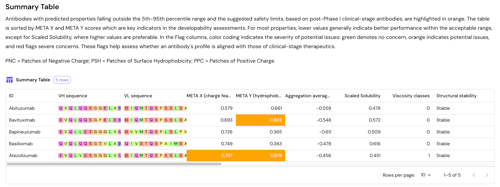
- META X (charge feature) : Represents the averaged rescaled ranks of ELISA (enzyme-linked immunosorbent assay), BVP (Baculovirus particle ELISA), PSR (poly-specificity reagent), CSI (clone self-interaction by biolayer interferometry), ACCSTAB (accelerated stability or AS), and CIC (cross-interaction chromatography) metrics. This composite score, which ranges from 0 to 1, reflects charge-associated properties; lower META X values suggest more favorable charge characteristics and reduced risk of cross- or self-interactions.
- META Y (hydrophobicity feature) : Derived by averaging rescaled ranks from SMAC (stand-up monolayer adsorption chromatography) and HIC (hydrophobic interaction chromatography) metrics. This score, which ranges from 0 to 1, captures hydrophobicity-related properties; lower META Y values indicate lower hydrophobicity, which is generally favorable for solubility and low aggregation risk.
- Aggregation average score : Represents the mean residue-level aggregation propensity across the antibody structure, providing a normalized estimate of the molecule’s overall aggregation tendency. More negative scores suggest reduced aggregation risk.
- Scaled Solubility : A normalized solubility score (ranging from 0 to 1) indicating predicted solubility based on sequence features. Higher values indicate better solubility.
- pI : Isoelectric point. It is the pH at which a molecule, typically a protein, carries no net electric charge. Relates to solubility, stability, and behavior in electrophoretic or chromatographic systems. pI also strongly correlates with Heparin Affinity Chromatography (HAC), which is used to assess non-specific binding.
- PSH_flag : Patches of Surface Hydrophobicity. Measures the size of solvent-exposed hydrophobic residues in CDR regions. This flag indicates values which are normal (green), extremal (orange) or out of the main distribution for clinical-stage antibodies (red). High levels of hydrophobicity, particularly in CDRs, have been implicated in aggregation, viscosity, and polyspecificity.
- PSH flag: Patches of Surface Hydrophobicity. Measures the size and amount of solvent-exposed patches of hydrophobic residues in CDR regions. This flag indicates values which are normal (green), extremal (orange) or out of the main distribution for clinical-stage antibodies (red). High levels of hydrophobicity, particularly in CDRs, have been implicated in aggregation, viscosity, and polyspecificity.
- PNC flag: Patches of Negative Charge. This flag indicates values which are normal (green), extremal (orange) or out of the main distribution for clinical-stage antibodies (red). Patches of Negative Charge in the CDRs can be linked to high rates of clearance and poor expression levels
- PPC flag: Patches of Positive Charge. Measures the size and amount of solvent-exposed patches of positively charged residues in CDR regions. This flag indicates values which are normal (green), extremal (orange) or out of the main distribution for clinical-stage antibodies (red). Patches of Positive Charge in the CDRs can be linked to high rates of clearance and poor expression levels
- SFvCSP flag: Structural Fv Charge Symmetry Parameter. Measures the charge symmetry of the Fv domain. This flag indicates values which are normal (green), extremal (orange) or out of the main distribution for clinical-stage antibodies (red). Asymmetry can be associated with poor biophysical behavior.
- CDR length flag: The total length of all CDRs. This flag indicates values which are normal (green), extremal (orange) or out of the main distribution for clinical-stage antibodies (red). Longer CDRs can be associated with higher risk of developability issues, such as aggregation and immunogenicity.
- Viscosity classes : Classify the molecule as either low viscosity (0: <= 20 cP) or high viscosity (1: > 20 cP). High viscosity makes subcutaneous delivery difficult.
- num of DEV liabilities : Number of detected motifs associated with developability (DEV) liabilities (including both solvent-exposed and non-exposed motifs).
- num of fully exposed DEV liabilities : Number of detected motifs with fully solvent-exposed residues associated with DEV liabilities. These exposed motifs represent a higher potential risk, as they are more susceptible to solvent-driven chemical degradation.
- num of NS liabilities : Number of detected motifs associated with non-specificity (NS) liabilities (including both solvent-exposed and non-exposed motifs).
- Spatial positive charge map : Spatial positive charge map score in the Fv region (SCM_pos_Fv). Higher scores may indicate a greater risk of non-specific interactions, particularly with negatively charged molecules such as heparin. This metric correlates with Heparin Affinity Chromatography (HAC), which is commonly used to assess non-specific binding liabilities in antibodies.
Additional parameters (found in the consolidated_metrics.csv file )
- "HIC.pred" : "Hydrophobic Interaction Chromatography. The relative hydrophobicity of biomolecules based on their interaction with hydrophobic ligands on a chromatography resin under high-salt conditions."
- "SMAC.pred" : "Stand-up monolayer adsorption chromatography. "
- "SGAC.pred" : "Site-Directed Gradient Affinity Chromatography coupled with Self-Interaction Nanoparticle Spectroscopy. Measures solubility, and aggregation risk.",
- "CIC.pred" : "Cross-interaction chromatography. Measures propensity of a protein to interact with other proteins, indicating its cross-reactivity and non-specific binding tendency. ",
- "CSIBLI.pred" : "Charge-Stabilized Self-Interaction Biolayer Interferometry. This technique provides insight into colloidal stability and aggregation risk.",
- "ACSINS.pred" : "Affinity-Capture Self-Interaction Nanoparticle Spectroscopy. Measures valuate colloidal stability and developability risk",
- "HEK.pred" : "Human Embryonic Kidney cell expression titer. Evaluate protein expression.",
- "PSR.pred" : "Poly-Specificity Reagent. Assess the binding tendency of antibodies by detecting non-specific interactions with a mixture of membrane proteins.",
- "ELISA.pred" : "Enzyme-Linked Immunosorbent Assay. Measures the presence and concentration of a specific antigen or antibody using enzyme-linked detection on a solid surface.",
- "BVPELISA.pred" : "Baculovirus Particle ELISA. Assess the binding of antibodies to baculovirus particles displaying membrane proteins, to assess specificity and membrane context recognition.",
- "DSF.pred" : "Differential Scanning Fluorimetry. Assess the thermal stability of proteins by detecting changes in fluorescence as the protein unfolds with increasing temperature.",
- "ACCSTAB.pred" : "Accelerated Stability. Evaluate colloidal stability and aggregation risk after thermal or mechanical stress.",
- "Agg_score_sum" : "A structure-based score summing individual residue-level aggregation propensities. It uses an empirically calibrated amino acid aggregation scale derived from in vivo data to estimate overall aggregation risk.",
- "Agg_score_min" : "This metric is the minimum value amongst all Aggregation Scores.",
- "Agg_score_max" : "This metric is the maximum value amongst all Aggregation Scores.",
- "Agg_score_avg" : "This metric is the arithmetic mean of all Aggregation Scores.",
- "Aggregation average score" : "Represents the mean residue-level aggregation propensity across the antibody structure. This provides a normalized estimate of the molecule’s overall tendency to aggregate.",
- "percent-sol" : "Relative solubility compared to soluble E.coli proteins.",
- "scaled-sol" : "A normalized solubility score indicating predicted solubility based on sequence features. Higher values indicate better solubility.",
- "PSH" : "Patches of Surface Hydrophobicity. Measures the size of solvent-exposed hydrophobic residues in CDR regions. High levels of hydrophobicity, particularly in CDRs, have been implicated in aggregation, viscosity, and polyspecificity.",
- "PNC" : "Patches of Negative Charge. Measures the size of solvent-exposed negatively charged residues. Patches of Negative Charge in the CDRs can be linked to high rates of clearance and poor expression levels",
- "PPC" : "Patches of Positive Charge. Measures the size of solvent-exposed positively charged residues in CDR regions. Patches of Positive Charge in the CDRs can be linked to high rates of clearance and poor expression levels",
- "SFvCSP" : "Structural Fv Charge Symmetry Parameter. Measures the charge symmetry of the Fv domain.",
- "SCM_pos_Fv" : "Spatial positive charge map score in the Fv region. Higher scores may indicate a greater risk of non-specific interactions, particularly with negatively charged molecules such as heparin. This metric correlates with Heparin Affinity Chromatography (HAC), which is commonly used to assess non-specific binding liabilities in antibodies."
- "SCM_neg_Fv" : "Spatial negative charge map score in the Fv region. Higher scores may indicate a greater risk of non-specific interactions, particularly with negatively charged molecules such as heparin. This metric negatively correlates with Heparin Affinity Chromatography (HAC), which is commonly used to assess non-specific binding liabilities in antibodies."
- "SAP_pos_CDR": "Spatial aggregation propensity score of CDR regions. There is a moderate correlation between this score and the hydrophobic property (HIC and META Y)."
- "SAP_pos_Fv": "Spatial aggregation propensity score of the Fv domain. There is a moderate correlation between this score and the hydrophobic property (HIC and META Y)."
Liabilities
The liability tables summarize the developability and non-specificity motifs identified. Each row corresponds to a heavy (H) or light (L) chain of an antibody (ID). For each chain, the tables list potential liabilities, specific motifs in the sequence, and their start and end positions. The Region column indicates where the motif is located (e.g., CDR1, CDR2). Surface exposure describes whether the motif is solvent-exposed, which generally represents a higher potential risk due to increased susceptibility to solvent-driven chemical degradation. Present in germline shows whether the motif is naturally found in germline sequences, and present in therapeutics indicates if similar motifs exist in approved therapeutic antibodies. Such motifs are generally considered lower risk. The Severity column is categorized as high, medium, low, or undefined and indicates the inherent developability concern associated with each motif, where higher severity reflects a greater potential to cause issues and lower severity indicates a lesser concern. The Risk level is an overall assessment of the potential risk associated with each motif, derived by combining severity with contextual factors such as surface exposure, germline presence, and occurrence in approved therapeutics.
When a column contains multiple values inside brackets [], they are listed in the same order across all columns, meaning the first entry in each column corresponds to the same motif and liability. Empty brackets ([]) indicate that no motif or corresponding value was identified for that column.
The developability liabilities include the following common risk motifs: glycosylation, deamidation, isomerization, low solubility, high viscosity, glycation, integrin binding, CD11c/CD18 binding, fragmentation, unpaired cysteine, and missing cysteine.
The non-specificity liabilities include non-specificity and polyreactivity-inducing motifs.
The liability visualization can be seen in the LIABILITY PLOTS tab